
The Power of Community: How D49 Repealed a Discriminatory Bathroom Ban
The Power of Community: How D49 Repealed a Discriminatory Bathroom Ban
Nationwide, boards of education have become increasingly polarized over the last decade. While district priorities were once largely limited to budget balancing, facility improvements, and vital operations, many boards have recently shifted focus toward "hot-button" cultural issues. Unfortunately, transgender and gender-expansive students often bear the brunt of these shifts.
This trend has surfaced in Colorado as well, but a recent policy win in El Paso County proves that the radicalization of school boards is not insurmountable. When a community works together, it can make a marked difference for its students.
Last week, Falcon School District 49 (D49) repealed a policy implemented just last year: a ban preventing transgender students, staff, families, and guests from using restrooms that align with their gender identity. This policy—which defied Colorado law, decades of research, and the wishes of the D49 community—was ultimately repealed before it could be implemented.
This victory is the result of months of advocacy from D49 parents; Neighbors for Education D49 (NFE); and Inside Out Youth Services (IOYS), an organization that builds access, equity, and power with LGBTQIA2+ youth in the Tava-Kaavi (Pikes Peak) region.
Bathroom Bans and Transgender Rights
Bathroom bans gained prominence about a decade ago as the visibility of gender-expansive identities increased. In 2016, a North Carolina ban drew widespread criticism and boycotts. However, as misinformation regarding transgender youth has spread, a sharp divide has emerged.
In Colorado, such bans are indisputably illegal. The state’s robust anti-discrimination protections list gender identity as a protected class, ensuring no one is denied access to facilities based on who they are. Furthermore, a 2013 Colorado court ruling upheld the right of Coy Mathis, a six-year-old transgender girl, to use the school restroom matching her gender identity—a ruling that protects every student in the state.
These protections are grounded in clear evidence:
- Mental Health: Transgender youth who experience bathroom discrimination report significantly higher rates of clinical depression and suicide attempts compared to those who do not.
- Safety: There is no evidence that transgender individuals pose a risk to others in gendered spaces.
- Vulnerability: Transgender people are statistically much more likely to be victims of violence and harassment than perpetrators.
What Happened in D49?
On January 20, 2025, an executive order was issued that narrowly and erroneously defined sex as a set of immutable biological characteristics. While not a binding law, this order gave some school districts the "permission" they sought to discriminate, often under the guise of protecting federal funding. In March 2025, D49 attempted to pass a resolution echoing this harmful language.
While the full resolution never reached a vote due to legal counsel's advice, the district instead broke the resolution’s points into separate, actionable policies. This led to D49 banning transgender athletes and restroom use in the same year.
On September 11, 2025, the board introduced Policy JBAA (the bathroom ban). Typically, a policy is introduced at one meeting and voted upon the next. However, then-Board President Lori Thompson fast-tracked the vote for a special meeting on September 23. By labeling it a "special meeting," Thompson exercised her discretion to bar public comment, effectively silencing opposition.
In response, IOYS mobilized its Activist Network. Since the public was barred from speaking, they flooded the board with emails and showed visual support at the meeting. Despite this, Policy JBAA passed 3–2, with Directors Thompson, Deb Schmidt, and Jamilynn D’Avola voting in favor.
The Path to Repeal
The tide turned in November 2025 when Director D’Avola was not re-elected. Her successor, Holly Withers, joined the board, shifting the leadership dynamic. The new Board President, Marie La Vere-Wright, placed Policy JBAA back on the agenda.
The repeal followed a two-step process:
- January 16, 2026: The board voted 3–2 to suspend the policy, halting its implementation.
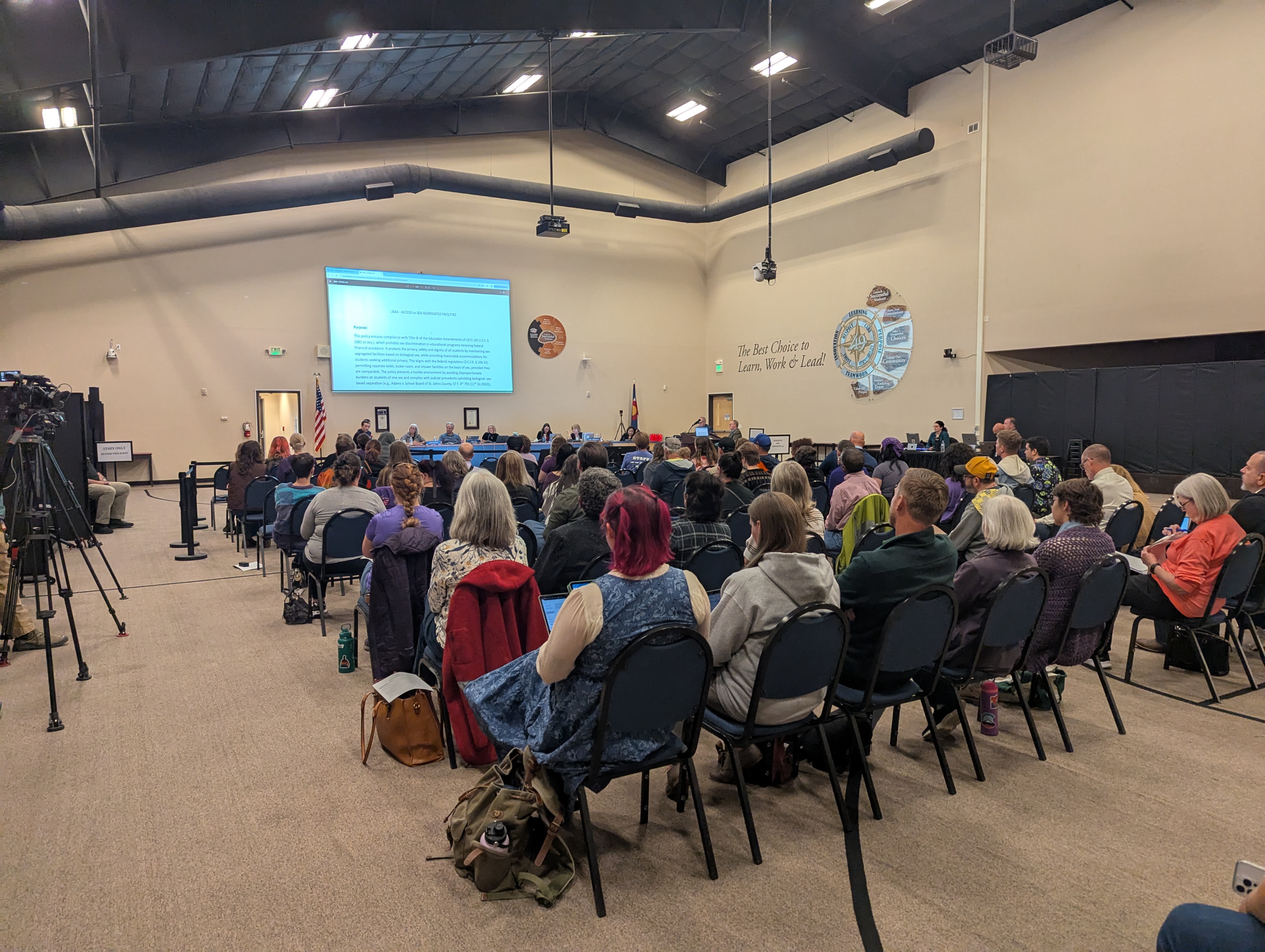
- January 27, 2026: A special meeting was called for a full repeal. Unlike the previous year's special meeting, this one allowed for public comment.
Advocates packed the room wearing purple. One parent noted during public comment: “If children feel unsafe because of the potential of a trans person being in a bathroom, that is a problem of the parents... My right as a parent is to choose what is best for my child, especially if it doesn’t impact other children negatively.”
Despite heckling from the opposition and calls from Director Schmidt to delay the repeal for a "survey," the board voted 3–2 to permanently repeal Policy JBAA.
Lessons Learned
Change takes time, but it is possible. The radicalization of school boards was an intentional, multi-year investment by outside groups, and undoing that damage requires equal persistence.
The key is a realistic and tiered approach to advocacy. IOYS understands that not everyone can attend every meeting. The Activist Network allows community members to contribute in ways that fit their capacity—whether through emails, petitions, or simply spreading the word.
When a community works together, it can overcome even the most daunting political challenges. In D49, 26,000 students can now focus on their academics and extracurriculars without the fear of being barred from a restroom.
One Colorado is incredibly proud of the work Inside Out Youth Services (IOYS) and Neighbors for Education have accomplished in D49. We know this work is long and exhausting—but when we relentlessly pursue justice, we win.
We believe every young person deserves the same freedom, respect, and autonomy as the adults in their lives. This begins with respecting names and pronouns and extends to ensuring full access to gender-affirming care, sports, and safe facilities.
Our youth are our future. It is our privilege to protect them, to foster their growth, and to defend their right to the same journey of self-discovery we all enjoy. We remain deeply committed to uplifting both these students and the organizations, like IOYS, that walk beside them.
"Repealing Policy JBAA is a win for trans students and a victory for the advocates who fought to ensure every young person belongs in D49 schools." — Angie Reader, Executive Director of Inside Out Youth Services
Angie’s words reflect our core Colorado values: Freedom. Dignity. Respect.
A win for trans students is a win for all students. We share a collective humanity. We all deserve to participate in a society that is equally ours—one where we can play sports, use a restroom, or go to the grocery store without interference from officials who do not understand our identities or our communities.
In the coming months, we urge you to think collectively. The issues facing marginalized communities aren't isolated; they impact us all. When we protect the most vulnerable among us, we secure freedom for everyone.
